
Clear the Deck Lenormand is an introspective game inspired by Petit Lenormand. It was designed within the playful world of piracy and will help you discover a whole new side of yourself!
- Do you have a problem?
- Is there something on your mind?
- Are you going over the same situation in your head?
The Clear the Deck Lenormand is here to help you see things more clearly by telling you a different story from the one you’re currently experiencing, so you can consider a solution you might not have thought of!
Ask him an open-ended question, draw a few cards, and create your own personal legend.
35 €
Excluding shipping costs
Story

Today, many people use the Petit Lenormand for divination, attributing mystical powers to it through the use of complex interpretation techniques.
But it is interesting to learn about the origins of the Petit Lenormand to understand that this method did not originate with Mlle Lenormand and Clear the Deck Lenormand was born.
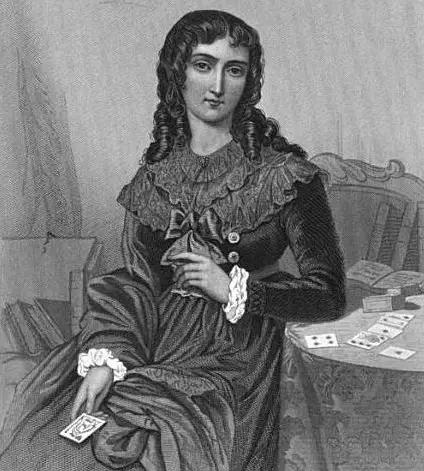
This game is often attributed to Marie-Anne-Adélaïde Lenormand, the Sibyl of St. Germain, but it originated in Germany in the late 18th century. It is a game called Das Spiel der Hoffnung (The Game of Hope), created by Johann Kaspar Hechtel in 1799. A combination of a card game and a board game, it was played for entertainment in European salons.
It was toward the end of the 19th century that a self-proclaimed descendant of Mlle Lenormand claimed it as his own, inventing along the way a system of divination known as “the grand tableau,” based on… absolutely nothing!
While the symbols on the cards evoke a journey of self-discovery, this deck was never created for esoteric or occult purposes.
The Petit Lenormand continues to fascinate and gain popularity because many of its symbols embody universal archetypes. As a result, they can be adapted to fit any context (just like the tarot).
My first task was to identify these archetypes and define the issues associated with them. I felt it was important to link them to current concerns that I regularly encounter in my community.
But I also wanted to broaden the range of possibilities by inviting the players of my game to reflect on the world they inhabit and explore the role they wish to play within it.
Finally, I redesigned all the cards using pictograms to give them a modern, easy-to-read look, and set them in a pirate-themed world to add an air of mystery, subversiveness, and a libertarian spirit.
Some of the cards had to be renamed, so I looked for parallels in the myths, legends, stories, beliefs, and superstitions of the maritime world.
Clear the Deck is also the name of my Instagram account; I felt it was important that my first self-published project could be easily linked to my social media activity.
“Clear the Deck” means to prepare for an event by taking action and addressing anything that might hinder its smooth execution.
All hands on deck, shipmates!

The Clear the Deck Lenormand is a deck of 43 cards. It includes:
- 36 cards from the traditional Petit Lenormand deck, reimagined in the world of pirates
- 3 alternative cards for the Candle (Coffin), the Whale / Shark (Bear), and the open or closed Logbook (Book)
- 4 additional cards – The Board, The Cat, The Kraken, and The Cannon
The cards have been renamed and associated with pirate symbols, objects, beliefs, and customs. This is your chance to learn more about this fascinating marginal community that roamed the oceans in the 17th and 18th centuries!
When creating this game, another goal was:
- to eliminate the concept of gender
- to remove the religious aspect
- to make it more inclusive.
So, the child and stork cards have been removed to make it easier for those who don’t want them to find their way around.
Men and women give way to pirates and sea dogs. The Cross card has been replaced by a beautiful illustration found in the work of Rozenn Grosjean (@rozennillustration on Instagram), thanks to whom I discovered the Petit Lenormand deck.
The game comes with a 140-page logbook very comprehensive guide to learning how to use the Clear the Deck Lenormand.
There you can discover:
- The Story of Miss Lenormand
- The History of the Game “Le petit Lenormand”
- the use and evolution of the game
- The world of piracy and its history
- How to give this game a “Clear the Deck” twist
- card-by-card interpretation (story, symbolism, polarity, keywords)
- How to ask a question
- A Guide to Reading Maps
- examples of spreads
- sources
A small 24-page booklet of keywords is also included in the box so you can take the game with you wherever you go.
The cards:
– Poker size (63×88 mm)
– 330 gsm black-core paper
– Gold ink to highlight key elements on the cards
– Matte finish
The box:
– Rigid, 2-piece
– 1.5 mm cardboard
– Gold ink printing
– Silky matte finish
The logbook:
– A6 size
– 90 gsm recycled paper
– Sewn binding, so the pages won't come loose even with frequent handling
– 300 gsm cover with matte lamination and gold foil stamping
– Pages for jotting down your own keywords and ideas
The Little Book of Keywords:
– Box size
– 100 gsm paper
– Stapled binding
The card designs are guaranteed to be AI-free. Each design was created using Illustrator in vector format.


This game is my first self-published project.
It is currently being translated into English.